

VMSA-2026-0007: Critical VM Escape in VMware Workstation and Fusion, Patch to 26H1u1

A critical flaw in VMware Workstation and Fusion lets a guest VM break out and run code on the physical host it sits on, the kind of bug that defeats the entire point of using a VM to isolate something untrusted. Broadcom published the fix on September 3, 2026 as VMSA-2026-0007, and it applies to the desktop virtualization tools many admins run for labs and malware analysis, not the datacenter ESXi or vCenter products.

Quick guide
- Open VMware Workstation or Fusion and check Help, About for the version number.
- If you are on version 25H2 or 26H1 and have not applied the September update, you are affected.
- Download and install version 26H1u1 from Broadcom’s support portal, which fixes both flaws.
- If you cannot patch immediately, avoid giving local administrator rights inside guest VMs you do not fully trust, since both flaws require that level of access inside the guest first.
- Pay particular attention to VMs used for malware analysis or running untrusted code, since VM escape is exactly the outcome that setup is meant to prevent.
- After updating, confirm the new version number shows in Help, About on each machine that runs Workstation or Fusion.
The two vulnerabilities
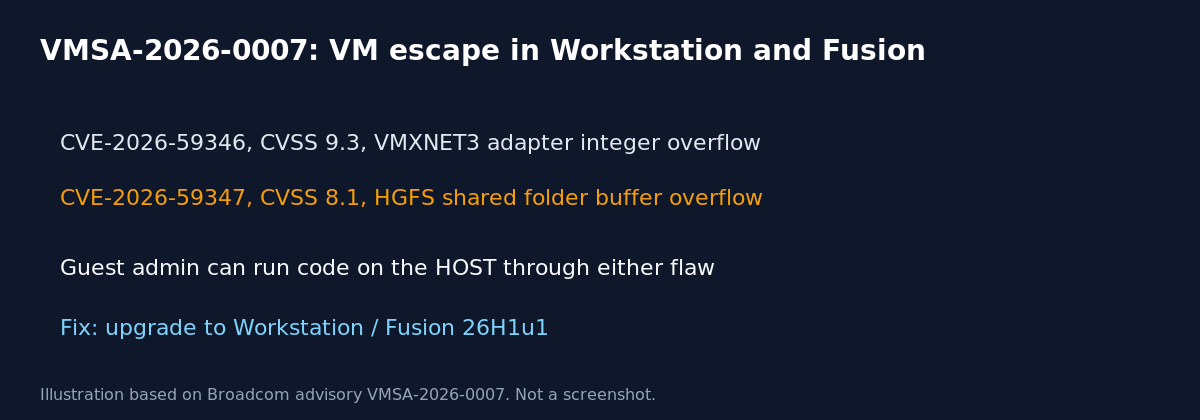
CVE-2026-59346: VMXNET3 integer overflow, CVSS 9.3
This is an integer overflow flaw in the VMXNET3 virtual network adapter. A malicious actor who already has local administrator privileges inside a VM configured with a VMXNET3 adapter can exploit it to execute code on the host machine, escaping the VM sandbox entirely. At a 9.3 CVSS score this sits in the critical range, and it was reported independently by multiple researchers, including through Trend Micro’s Zero Day Initiative.
CVE-2026-59347: HGFS buffer overflow, CVSS 8.1
This is a stack based buffer overflow in the Host-Guest File System, the component that handles shared folders between a VM and its host. An attacker with local administrator privileges inside the guest can exploit it to execute code as the host’s VMX process, the process responsible for running that VM. It was reported by researchers at Tencent’s Xuanwu Lab.
Both flaws affect VMware Workstation versions 25H2 and 26H1 on any host operating system, and VMware Fusion versions 25H2 and 26H1 on macOS. Broadcom’s 26H1u1 release fixes both.
Why the local administrator requirement does not make this low priority
Both bugs need local administrator rights inside the guest before they work, which sounds like a limiting factor until you consider who actually uses Workstation and Fusion. Malware analysts deliberately run untrusted, hostile code with full rights inside a VM specifically because the VM boundary is supposed to contain it. A VM escape bug is the worst possible outcome in exactly that scenario, turning the safety mechanism into the attack path. The same applies to any VM you use to test software you do not fully trust, contractor supplied images, or anything downloaded from an unverified source.
What actually goes wrong
The realistic risk is quieter than a headline breach. An analyst detonates a sample in what they believe is an isolated lab VM, and if that host is unpatched, the malware or a manually crafted exploit chain could reach the analyst’s actual workstation. On a developer machine, a VM built to test unfamiliar or unverified code stops being a safety boundary the moment the underlying Workstation or Fusion build is vulnerable. Patching desktop virtualization tools gets skipped more often than server hypervisors because they feel like personal tools rather than infrastructure, which is exactly why this one is worth checking today.
FAQ
Does this affect ESXi or vCenter?
No. VMSA-2026-0007 covers VMware Workstation and Fusion, the desktop products. ESXi and vCenter have had their own separate advisories and are not covered by this fix.
Can this be exploited without administrator rights in the guest?
No. Broadcom’s advisory states both flaws require local administrative privileges inside the affected VM before they can be used to reach the host.
Where can I get the fixed version?
Broadcom’s support portal hosts the 26H1u1 release for both Workstation and Fusion, listed under advisory VMSA-2026-0007.
Sources
Broadcom Security Advisory VMSA-2026-0007, published September 3, 2026.